

Residential Energy Storage System – Core Components Explained
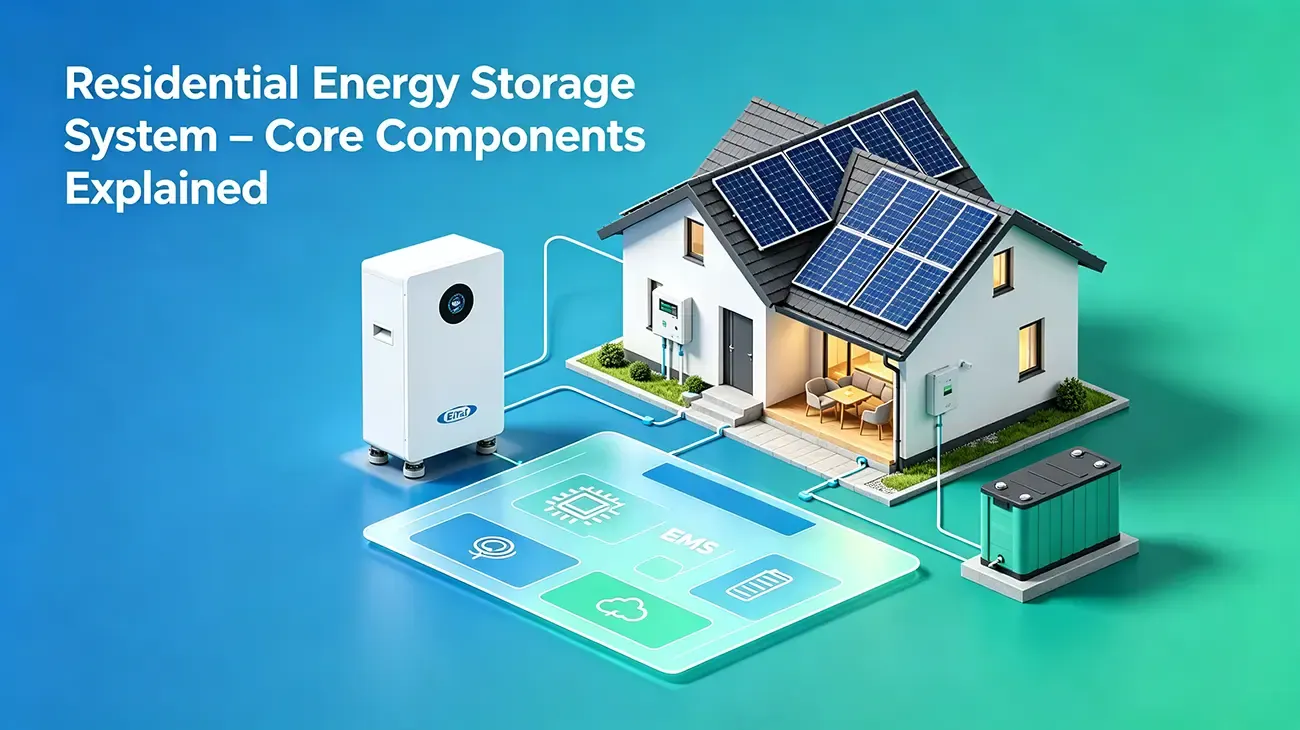
A complete residential energy storage system consists of the inverter, battery pack, Battery Management System (BMS), Energy Management System (EMS), and auxiliary components. These work together to store, convert, and intelligently dispatch electrical energy. Drawing on real product data from EITAI (Xiamen) New Energy Technology Co., Ltd., this article breaks down the function, technical principles, and selection criteria of each core component, helping you make informed, cost‑effective decisions.
1. The Power Conversion Hub – Hybrid Inverter
The inverter is the central interface between the battery, the grid, and household loads. It converts DC power from solar panels into AC for home use, or converts AC from the grid into DC to charge the battery. It also manages grid‑tied/off‑grid switching and MPPT (Maximum Power Point Tracking).
Key selection points:
Communication compatibility with the BMS – The inverter must exchange real‑time data (via CAN, RS485, etc.) with the BMS to adjust charging/discharging strategies.
Power rating – Should cover peak household loads and match the battery’s maximum discharge current.
Battery–inverter communication must be checked for the complete battery and inverter model, regional version, BMS/firmware, voltage window, protocol and cable pinout. CAN or RS485 interfaces and a shared brand name do not establish compatibility. Request the applicable connection instructions and commissioning requirements.
2. The Energy Core – Battery Pack
The battery pack is the “fuel tank” of the system. Its energy density, cycle life, and safety directly determine overall performance. Today, lithium iron phosphate (LFP) is the dominant choice for residential use, though sodium‑ion and lead‑acid are used in niche scenarios.
Technology comparison & selection guidance:
LFP (Lithium Iron Phosphate) – The top choice for homes. The cathode is LFP and the anode is carbon; lithium‑ions move between electrodes during charge/discharge. Advantages: excellent safety, long cycle life (typically ≥6,000 cycles). For example, EITAI’s low‑voltage series (ELEMAGIC‑5.1/10.2 LV) offer 6,000 cycles, while the liquid‑cooled series (ETBTMS‑16LV) reaches over 11,000 cycles. Energy density is slightly lower than ternary lithium, but more than sufficient for daily household use.
Ternary lithium – Higher energy density and faster charging, but poorer thermal stability and higher cost; used only in a few high‑density applications.
Sodium‑ion – An emerging technology with lower cost and better low‑temperature performance, but cycle life and energy density still need improvement; suitable for cold or remote areas.
Critical parameters and selection tips (with EITAI data):
Capacity sizing – Based on daily household consumption and PV array size. EITAI offers modules from 5.12 kWh (ELEMAGIC‑5.1 LV) up to 16.08 kWh (ELEMAGIC‑16 LV), with parallel connection of up to 15 units for flexible scaling.
Usable energy (DoD) – Pay attention to usable capacity at 90% DoD. For instance, the ELEMAGIC‑10.2 LV has a nominal 10.24 kWh but delivers 9.22 kWh usable, preventing deep discharge damage.
- Cycle-test results depend on depth of discharge, temperature, charge/discharge rate and the stated capacity-retention threshold. They cannot be converted directly into guaranteed operating years. Check the current model datasheet, calendar-ageing assumptions and written warranty terms. Confirm warranty duration, capacity-retention conditions, exclusions, repair or replacement terms and service responsibilities in the written quotation for the supplied model. Technical support and a free repair warranty are different services; this article does not establish either duration.
Charge/discharge rate – Residential systems typically use 0.5C–1C. EITAI low‑voltage products support up to 120 A discharge (e.g., ELEMAGIC‑10.2 LV), and high‑voltage units up to 200 A (ET‑HV76.8V314Ah), enough for simultaneous operation of high‑power appliances.
Temperature adaptability – In cold regions, choose models with built‑in heating. EITAI’s liquid‑cooled series (ETBTMS‑16LV) uses self‑developed silicone foam insulation and operates from ‑20 °C to 60 °C, ensuring stable performance in both freezing and hot climates.
Mounting options – Wall‑mounted designs save floor space (ELEMAGIC‑5.1 LV is only 153 mm thick); floor‑standing, rack‑mounted, and integrated cabinet versions are also available.
3. The Control Center – Battery Management System (BMS)
The BMS continuously monitors cell voltage, current, temperature, and state of charge (SoC). It performs cell balancing and provides safety protection – it is the key to ensuring battery safety and longevity.
Core functions and principles:
State monitoring – Precise measurement of voltage, current, and temperature, with SoC and state‑of‑health (SoH) estimation. SoC accuracy is a critical metric.
Balancing – Active balancing (current ≥1 A) is faster and suits large‑capacity systems (>10 kWh); passive balancing is adequate for smaller systems (<5 kWh) but requires attention to heat dissipation.
Safety protection – Immediately disconnects the circuit upon over‑charge, over‑discharge, over‑current, or over‑temperature, and sends alarms to the inverter.
Communication – Uses CAN, RS485, or Ethernet to exchange data with the inverter and EMS, enabling coordinated control.
EITAI in practice:
In collaboration with top BMS suppliers PACE and UDAN, EITAI has developed a built‑in WiFi/Bluetooth dual‑mode monitoring module for its battery systems. Through a mobile app, users can:
Local control – Bluetooth direct connection, no account needed, plug‑and‑play, real‑time cell status display.
Remote monitoring – WiFi connection allows remote parameter adjustment, firmware upgrades, and fault alerts.
This feature is standard across low‑voltage (e.g., ELEMAGIC‑5.1 LV) and high‑voltage (ET‑51.2V100Ah‑HV) series, greatly improving user experience.
Selection tips:
Choose a BMS with SoC accuracy ≥95%.
Verify communication protocol compatibility with your inverter (EITAI supports CAN, RS485, RS232).
For systems ≥10 kWh, active balancing is recommended – EITAI’s high‑voltage rack models (ET‑51.2V200Ah‑HV) feature active balancing to extend life.
4. System Integration & Advanced Solutions
Beyond the three core components, modern residential storage is moving toward intelligent, integrated systems. EITAI offers several value‑added solutions:
Integrated high‑voltage stack system – E.g., ELEMAGIC‑10.2 HV, with a built‑in boost module that raises 51.2 V to 384 V, directly matching three‑phase hybrid inverters, reducing external equipment and saving installation space.
Liquid‑cooled thermal management – For high‑power or hot climates, EITAI’s liquid‑cooled series (ETBTMS‑16LV/9.6HV) use heat‑pump technology and liquid circulation to keep cell temperature differences within ±2 °C, boosting cycle life to 11,000 cycles – ideal for year‑round high‑demand homes or small businesses.
Container‑type storage – For large‑capacity needs (e.g., villas or communities), EITAI offers 306 kWh and 510 kWh outdoor container solutions, integrating fire protection, air conditioning, and EMS with IP65 protection, operating from ‑30 °C to 60 °C.
5. Summary & Recommendations
For end‑users, understanding each component’s role and matching logic helps avoid “over‑specified but underperforming” systems.
Confirm warranty duration, capacity-retention conditions, exclusions, repair or replacement terms and service responsibilities in the written quotation for the supplied model. Technical support and a free repair warranty are different services; this article does not establish either duration.
As technology evolves, residential storage is shifting from a mere backup power source to an intelligent energy manager. Choosing a professional manufacturer like EITAI – with a complete product line, in‑house BMS, and advanced thermal control – will make your green energy transition safer, more efficient, and worry‑free.