

Solar Battery kW vs kWh: How to Match Capacity, Power Output, and Backup Time
A practical sizing guide for solar installers and energy storage distributors.
When a customer asks for a “10 kWh solar battery,” the next question should be: What does the battery need to power, and for how long?
Two projects with similar daily energy consumption can require different battery configurations. One customer may need lighting, refrigeration, and internet access throughout an outage. Another may expect pumps, cooking appliances, and air conditioning to operate together.
For installers and distributors, understanding the difference between battery energy capacity and power output is essential to preparing accurate proposals. A complete assessment should establish how much energy the customer needs, how much power the system must deliver, and whether the battery and inverter can meet
1. Understanding the Difference Between kW and kWh
Kilowatt-hours, or kWh, describe stored energy. This figure helps determine how long a battery can supply a given load.
Kilowatts, or kW, describe power. This figure helps determine which loads can operate simultaneously.
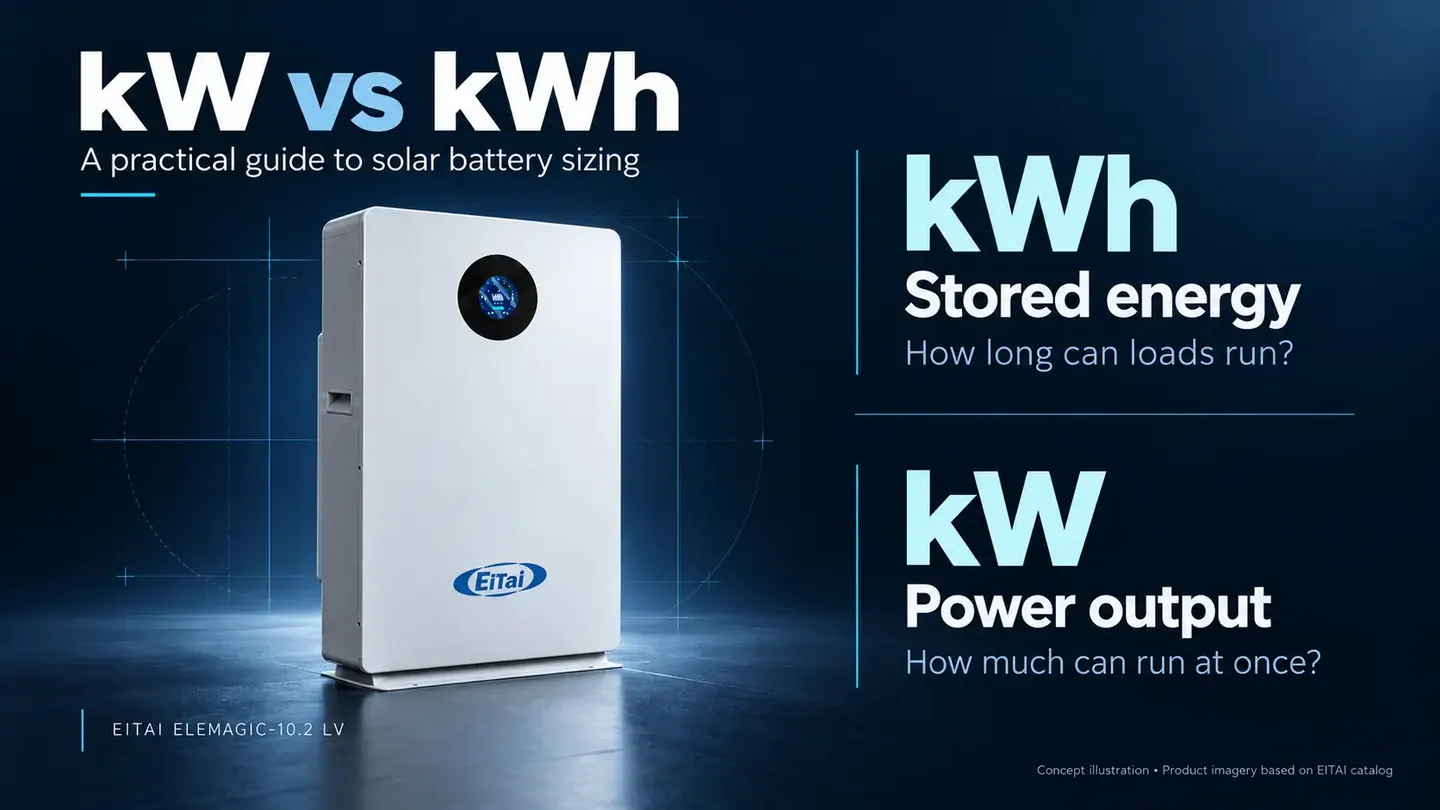
For example, a constant 1 kW load consumes 4 kWh over four hours. A constant 4 kW load consumes the same amount of energy in one hour, but it requires a system capable of delivering four times as much power.
This distinction matters when discussing customer expectations. A battery may store enough energy for several hours of essential backup while its discharge-power limit restricts the appliances that can operate at the same time.
When reviewing a battery datasheet, installers should examine nominal energy, usable energy, rated discharge power, and charge/discharge current limits. Where peak or surge capability is specified, its permitted duration and operating conditions must also be checked.
A maximum-power figure alone should not be treated as a continuous operating rating.
2. Estimating Backup Time from Available Energy
A useful starting point for estimating battery-only backup time is:
Backup time (hours) ≈ Available battery energy (kWh) × DC-to-AC efficiency ÷ Average AC load (kW)
Available energy depends on the starting state of charge and the configured discharge floor. When using a manufacturer’s usable-energy figure, check which discharge window it already includes.
For example, the EITAI ELEMAGIC 10.2K-LV product page lists 10.24 kWh of nominal energy and 9.22 kWh of usable energy at 90% depth of discharge.
Using 9.22 kWh of available energy and an assumed 95% conversion efficiency gives:
9.22 × 0.95 ≈ 8.76 kWh of AC energy
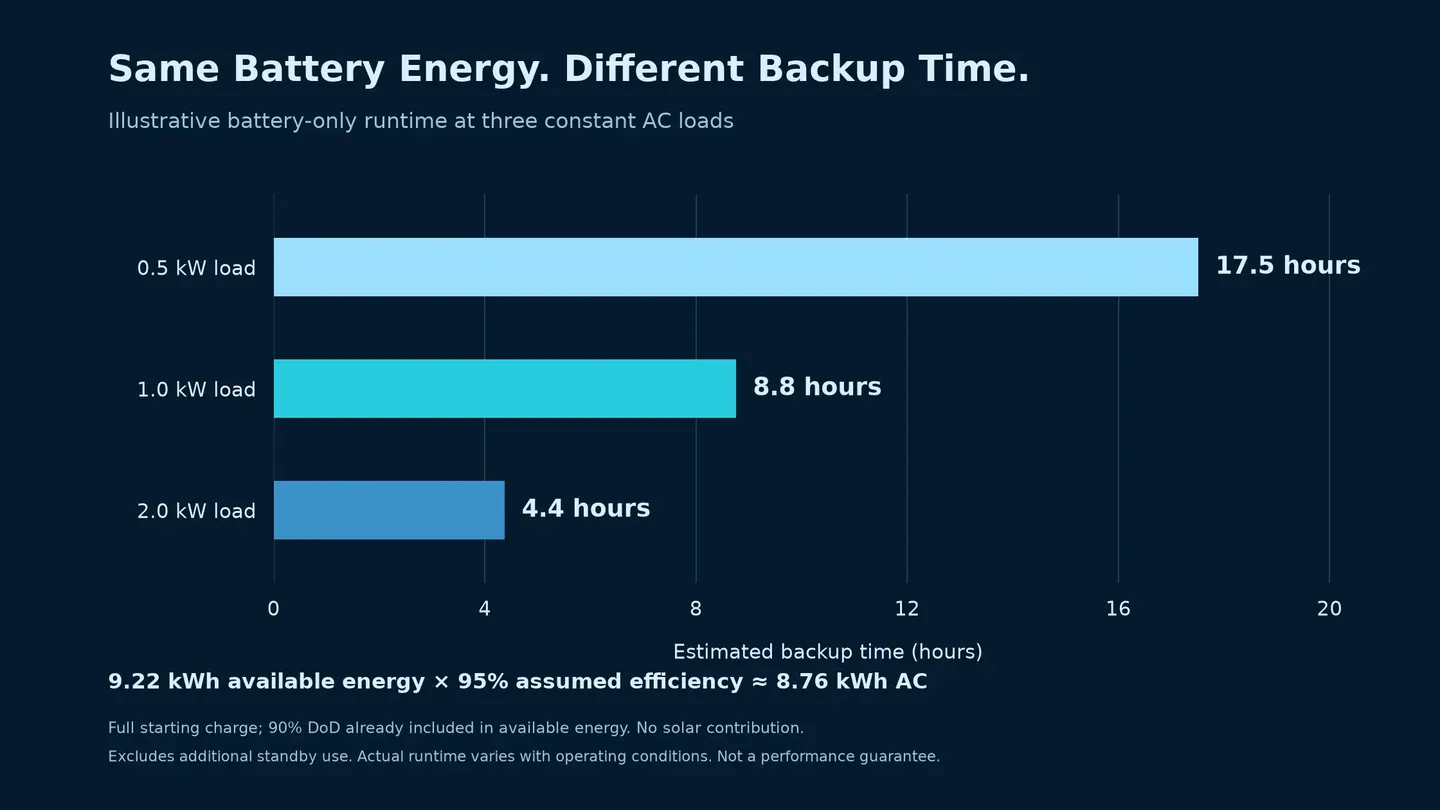
Under these assumptions, backup time is approximately 17.5 hours at 0.5 kW, 8.8 hours at 1 kW, or 4.4 hours at 2 kW.
These are calculated examples rather than guaranteed product runtimes. They assume a full starting charge, the stated usable-energy window, no solar contribution, and no separate allowance for standby consumption. Actual performance also depends on temperature, battery condition, system settings, and changing loads.
Because the 9.22 kWh figure already accounts for 90% DoD, do not multiply it by 90% again.
The 95% efficiency used here is an illustrative assumption. For a project estimate, use the selected inverter’s efficiency at the expected operating load. Published inverter specifications show that conversion efficiency can vary with load.
3. Checking Discharge Power and Battery Current
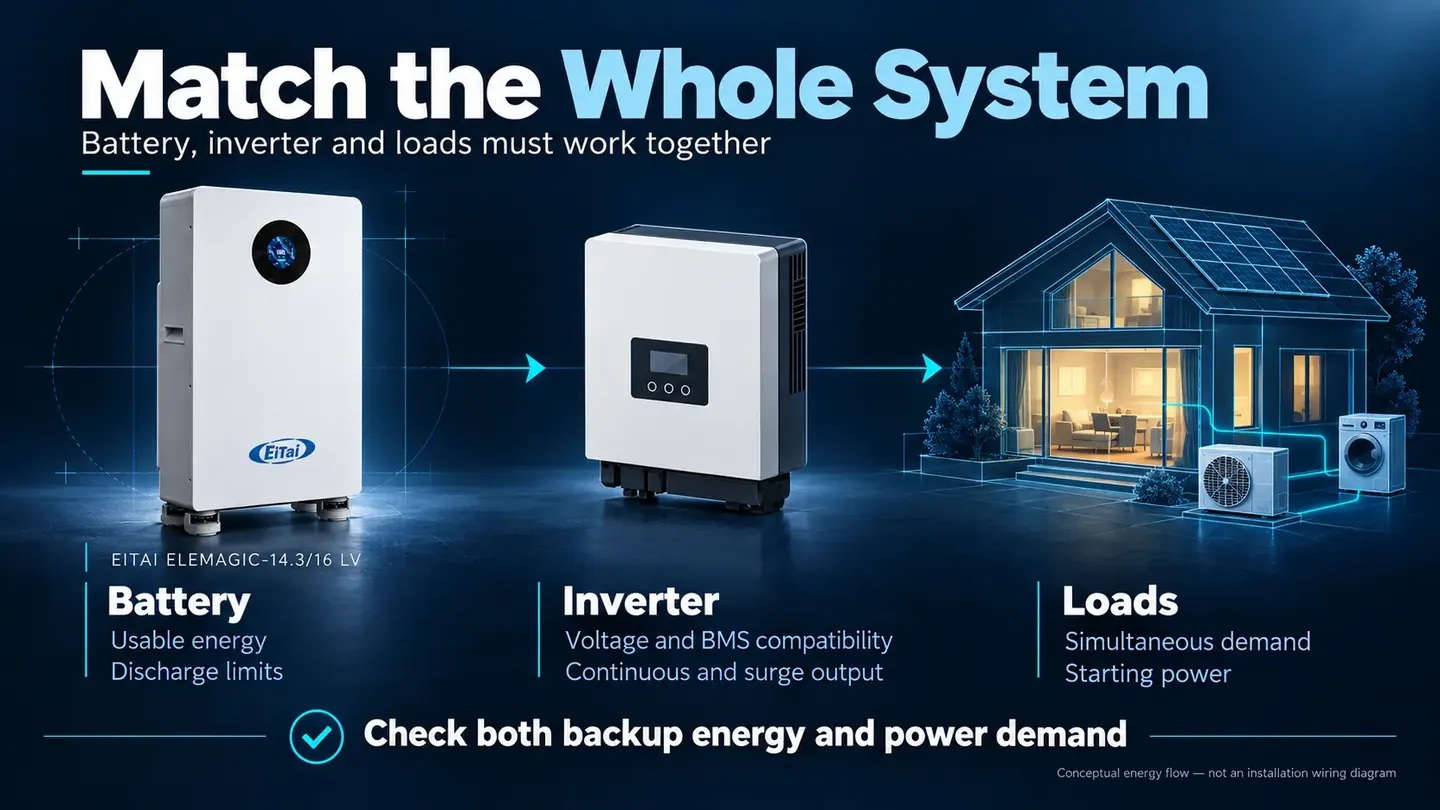
An energy calculation can show sufficient backup capacity while the proposed system still lacks the power required by simultaneous loads.
Approximate battery-side DC current can be estimated as:
Battery current (A) ≈ AC load power (W) ÷ [Battery voltage (V) × Inverter efficiency]
For a hypothetical 5,000 W AC load, a 48 V battery voltage, and 95% inverter efficiency:
5,000 ÷ (48 × 0.95) ≈ 110 A
This calculation shows why discharge-current limits deserve attention during selection. A battery with sufficient stored energy must also be able to supply the current demanded by the inverter.
If battery voltage falls while AC load power remains constant, the required DC current rises. Installers should therefore assess current demand across the permitted operating range, including lower-voltage operation.
Starting loads require a separate check. Pumps and compressors may briefly demand substantially more power than they use during normal operation. Both the inverter and the battery system must support that demand for the required duration.
Manufacturer system-design guidance likewise evaluates continuous and surge DC current separately, accounting for inverter efficiency and low battery voltage.
4. Comparing EITAI Battery Options Beyond Capacity
The ELEMAGIC 10.2K-LV and ELEMAGIC 16K-LV illustrate why a battery comparison should consider both energy and power.
The ELEMAGIC 10.2K-LV has a nominal voltage of 51.2 V and a nominal capacity of 200 Ah. Its published specifications list 10.24 kWh of nominal energy, 9.22 kWh of usable energy at 90% DoD, and 4.1 kW of rated DC power. The recommended charge/discharge current is 80 A, with a listed maximum of 120 A.
The ELEMAGIC 16K-LV has a nominal voltage of 51.2 V and a nominal capacity of 314 Ah. Its published specifications list 16.08 kWh of nominal energy, 14.47 kWh of usable energy at 90% DoD, and 7.17 kW of rated DC power. The recommended charge/discharge current is 140 A, with a listed maximum of 200 A.
The larger model provides more stored energy and a higher published rated DC power. Whether either model suits a project depends on the customer’s load profile and the complete system configuration.
Battery-side DC power should not be presented as guaranteed AC power at the appliances. Inverter conversion losses, inverter output limits, BMS limits, temperature, and state of charge must also be considered. Confirm the conditions and permitted duration associated with maximum ratings before using them in a design.
5. Building a Better Battery Selection Process
The ELEMAGIC 10.2K-LV and ELEMAGIC 16K-LV illustrate why a battery comparison should consider both energy and power.
The ELEMAGIC 10.2K-LV has a nominal voltage of 51.2 V and a nominal capacity of 200 Ah. Its published specifications list 10.24 kWh of nominal energy, 9.22 kWh of usable energy at 90% DoD, and 4.1 kW of rated DC power. The recommended charge/discharge current is 80 A, with a listed maximum of 120 A.
The ELEMAGIC 16K-LV has a nominal voltage of 51.2 V and a nominal capacity of 314 Ah. Its published specifications list 16.08 kWh of nominal energy, 14.47 kWh of usable energy at 90% DoD, and 7.17 kW of rated DC power. The recommended charge/discharge current is 140 A, with a listed maximum of 200 A.
The larger model provides more stored energy and a higher published rated DC power. Whether either model suits a project depends on the customer’s load profile and the complete system configuration.
Battery-side DC power should not be presented as guaranteed AC power at the appliances. Inverter conversion losses, inverter output limits, BMS limits, temperature, and state of charge must also be considered. Confirm the conditions and permitted duration associated with maximum ratings before using them in a design.
6. Explaining Backup Performance to Customers
A useful proposal presents backup time together with its assumptions.
Estimated battery-only backup time is approximately 8.8 hours at a constant 1 kW AC load, assuming 9.22 kWh of available battery energy and 95% conversion efficiency, before additional system consumption.
This gives the customer a reference point. The installer can then explain how additional appliances, a lower starting charge, or a different reserve setting would change the result.
For larger projects, use a time-based load profile to calculate energy demand and assess the highest simultaneous power separately. This supports a configuration based on how the site actually operates.