

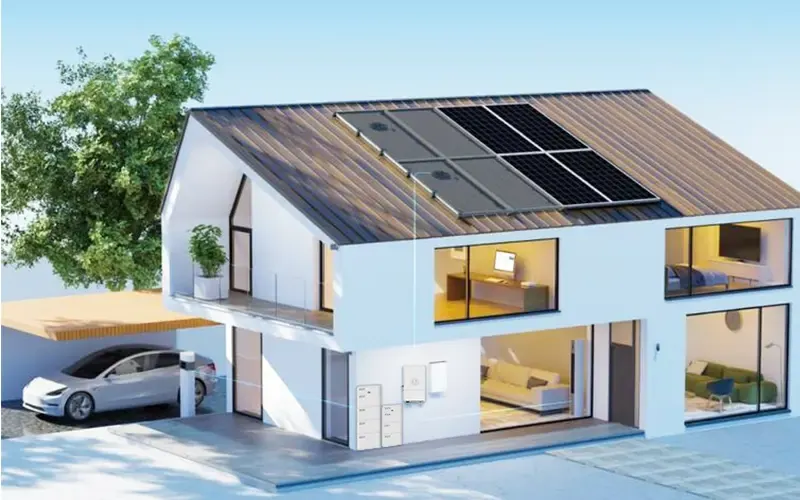
1: The reason for the internal composition of the battery cells
Chemical degradation: Lithium batteries undergo chemical reactions during use, leading to the gradual degradation of chemical substances within the battery, affecting its performance and capacity. Even when not in use, lithium batteries lose their energy storage capacity due to natural degradation.
- Cycle life limitations: The cycle life of lithium batteries is typically determined by the number of charge-discharge cycles. Even high-quality lithium batteries are subject to cycle life limitations during long-term use and charge-discharge processes.
- Environmental factors: Factors such as temperature, humidity, and usage frequency can affect the performance and lifespan of lithium batteries. For example, high temperatures accelerate battery degradation, while humidity and other adverse environmental conditions can also cause damage to the battery.
Cycle-test results depend on depth of discharge, temperature, charge/discharge rate and the stated capacity-retention threshold. They cannot be converted directly into guaranteed operating years. Check the current model datasheet, calendar-ageing assumptions and written warranty terms. Warranty coverage must be assessed from the actual written terms, not inferred from this general discussion.
- Cycle life and calendar life: The lifespan of lithium iron phosphate batteries is divided into cycle life and calendar life. Cycle life refers to the number of charge-discharge cycles the battery can undergo, while calendar life considers factors such as actual usage environment and storage conditions. Battery manufacturers typically only provide cycle life data because calculating calendar life is complex and time-consuming.
The above technologies can select appropriate methods according to actual application requirements and environmental conditions to collect and monitor the voltage within the lithium battery.
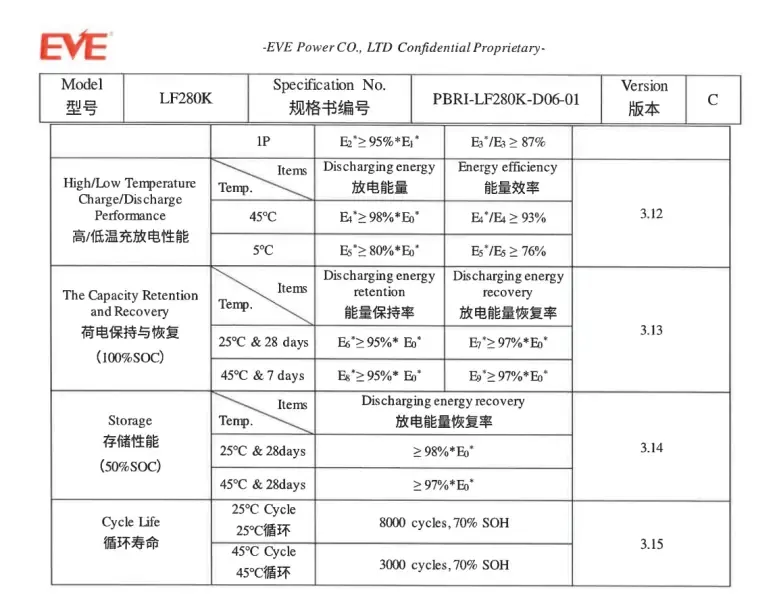
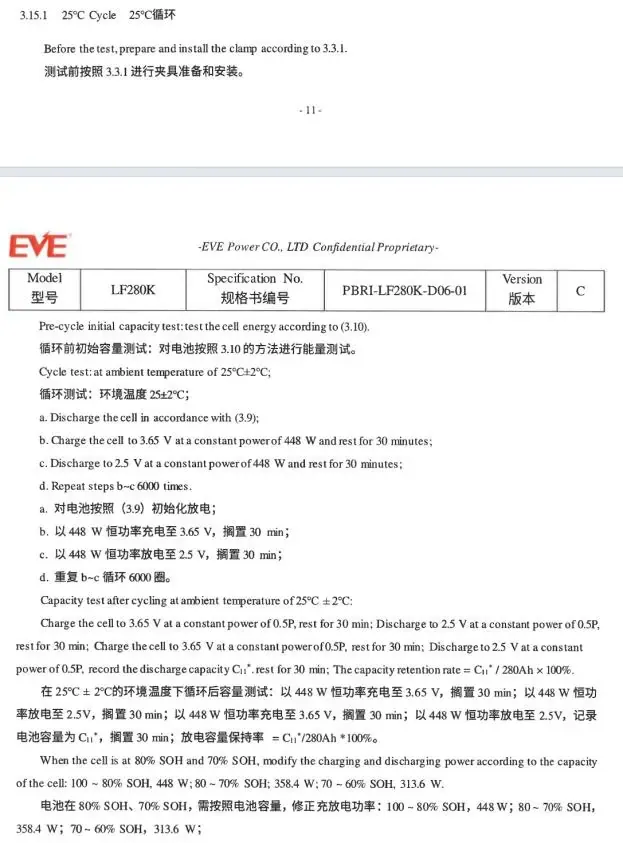
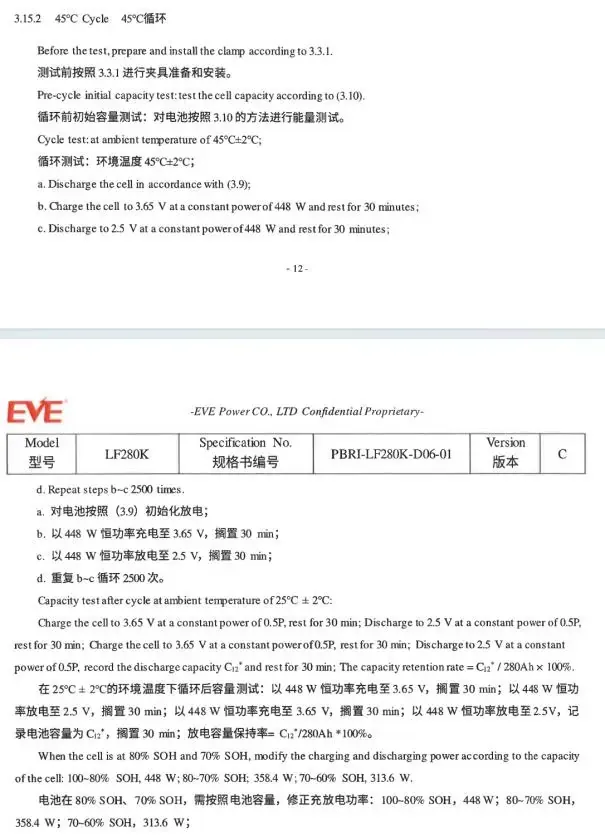
Above is a partial screenshot of the specifications for the well-known battery cell brand, EVE 280Ah. Regarding the cycle life testing, specific testing conditions are clearly indicated, including test temperature, pressure, charge-discharge rates, idle time during the process, and the standard for end-of-test capacity. However, determining calendar life under actual usage conditions is more complex due to numerous variables such as temperature fluctuations, high-power charge-discharge cycles, prolonged periods of low charge, and so forth. Nevertheless,
it is certain that the data will experience some degree of degradation.
Cycle life testing of the EVE 280Ah battery cell:
- Tested at 25°C, 0.5C charge-discharge rate, idle time of 0.5 hours, with degradation cutoff at SOH 70%, resulting in 8000 cycles.
- Tested at 45°C, 0.5C charge-discharge rate, idle time of 0.5 hours, with degradation cutoff at SOH 70%, resulting in 3000 cycles.
The difference in cycle life is as much as 5000 cycles due to a mere 20°C temperature variation.
In daily use, one charge-discharge cycle per day amounts to 365 cycles per year, totaling 3650 cycles over 10 years. Additionally, the power usage during operation must not exceed 0.5C rate (for instance, for a 280Ah battery, the 0.5C rate is 140A for charge-discharge). The operating environment temperature should not exceed 45°C. Furthermore, all battery cells within a pack must maintain uniform temperatures; without a thermal management system, significant temperature variations could occur, affecting the overall SOH (State of Health). Moreover, the battery should not experience overcharging, over-discharging, or prolonged periods of discharge.
Considering all these factors, it is evident that the healthy lifespan of the battery cell cannot be guaranteed for ten years.
2: Normal service life limit of BMS board
BMS (Battery Management System) is a device used in conjunction with monitoring energy storage battery status. It is primarily used for intelligent management and maintenance of individual battery cells, preventing overcharging and over-discharging, thereby extending battery life, and monitoring battery status. BMS typically manifests as a circuit board or hardware box.
The lifespan of BMS varies due to multiple factors, with the specific lifespan depending on the actual circumstances.
Here are some key factors affecting the lifespan of BMS:
- Quality and manufacturing process: High-quality BMS typically has a longer lifespan. Manufacturing processes, material selection, and assembly quality are crucial for the lifespan of BMS.
- Environmental conditions: The working environment of BMS affects its lifespan. For example, high temperatures, humidity, corrosive environments, or vibrations may shorten the lifespan of BMS.
- Usage patterns: The usage pattern of BMS is also essential. Frequent charge-discharge cycles, overcharging, over-discharging, excessive currents, etc., can affect its lifespan.
In summary, the lifespan of BMS is typically between 5-10 years, but the specific lifespan depends on the actual circumstances. If the circuit is not excessively bent or damaged, it can generally remain operational for a long time.
The lifespan of BMS is also influenced by other factors such as battery type, design, environment, and usage patterns.
Confirm warranty duration, capacity-retention conditions, exclusions, repair or replacement terms and service responsibilities in the written quotation for the supplied model. Technical support and a free repair warranty are different services; this article does not establish either duration.
3. Circuit aging and solder oxidation issues
The circuit consists of two parts: a power circuit and a sensing circuit.
Solder joints may oxidize and detach due to prolonged exposure to high humidity in the environment.
4. How do some manufacturers achieve their promised ten-year warranty
Here are the main methods:
- High individual battery cost, ensuring profitability even after replacing with new batteries after five years. This means customers need to pay a higher upfront cash value.
- Poor quality battery cells, such as used or batch cells, lower cost, and potentially allow for battery replacement or even replacement of multiple units. However, this approach is criticized for several reasons: first, maintenance and replacement consume customer’s time and cost; second, low-quality cells mean less usable battery capacity – for example, a 10-degree specification may actually only provide 5-degree capacity, significantly impacting customer experience; third, low quality increases the likelihood of cell leakage, self-ignition, and harmful liquid gas affecting health.
- Confirm warranty duration, capacity-retention conditions, exclusions, repair or replacement terms and service responsibilities in the written quotation for the supplied model. Technical support and a free repair warranty are different services; this article does not establish either duration.
- Implementing new technologies like thermal management systems inside battery packs. For example, liquid cooling technology can regulate the internal temperature of the battery pack, ensuring uniform temperatures throughout and essentially controlling the temperature within the ideal operating range for the battery cells.